
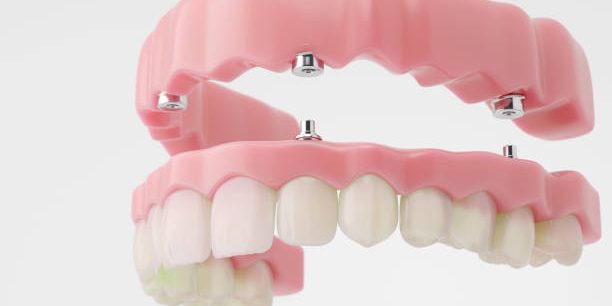
If you’re considering full mouth dental implants, one of the most common questions is simple:
Will it take one surgery or two?
The short answer:
Most patients can have full mouth dental implants placed in a single surgical visit. However, in some cases, a two-stage approach is recommended to ensure proper healing and long-term success.
The right approach depends on your bone quality, oral health, and overall medical condition. Here’s what you need to know.
What Are Full Mouth Dental Implants?
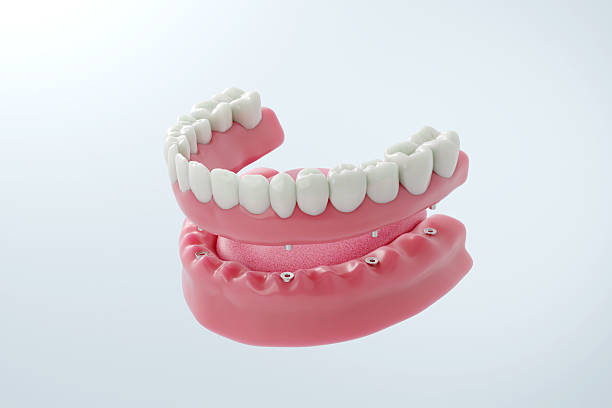
Full mouth dental implants replace all teeth in the upper jaw, lower jaw, or both using a fixed set of artificial teeth supported by implants.
The most common approach is All-on-4, a full-arch implant technique that uses four strategically positioned implants to support a complete set of fixed teeth. This method uses four strategically placed implants to support a full arch of teeth.
Variants include All-on-6 and other full-arch systems, depending on bone availability and treatment goals.
In simple terms:
Dental implants act as artificial tooth roots that support a full set of fixed teeth, restoring both function and appearance.
Read More: All-on-4 Treatment Process: What to Expect Step-by-Step
One Surgery vs Two: What Does It Actually Mean?
When patients ask this question, they are usually referring to two different things:
- Single vs dual arch treatment
(Are both upper and lower jaws done in one visit?) - One-stage vs two-stage implant protocol
(Is the implant placed once or in two separate procedures?)
Both are important, and often confused.
Can Upper and Lower Teeth Be Done in One Surgery?
Yes, many patients can have both arches treated in a single surgical session (known as full-arch or bimaxillary rehabilitation).
Clinical literature on full-arch implant restorations reports consistently high implant survival rates over multi-year follow-up periods. Your clinician can discuss what the evidence means for your specific situation.
Why choose one surgery?
- One anaesthetic event
- One recovery period
- Fewer appointments
- Faster overall transformation
For many patients, having both arches treated in a single session reduces the overall burden of treatment, with a single anaesthetic event and one recovery period.
When is it NOT recommended?
Your clinician may suggest staging treatment if:
- You have complex medical conditions
- Surgery time needs to be shorter
- Extensive extractions or grafting are required
- One jaw is significantly more complex than the other
One-Stage vs Two-Stage Implants: Key Difference
This is the more important distinction.
Two-Stage (Traditional) Approach
This method involves two separate procedures:
Stage 1:
Implants are placed and covered by gum tissue to heal.
Healing phase:
3–6 months for the implant to fuse with bone (osseointegration).
Stage 2:
A minor procedure exposes the implants, and the final teeth are attached.
This approach is often used when:
- Bone quality is lower
- Implant stability is not strong enough initially
- Healing needs to be more controlled
One-Stage (Immediate Loading)
Also known as “teeth in a day”, this approach allows implants and temporary teeth to be placed in the same visit.
Important:
The implants still take 3–6 months to fully integrate with bone. The temporary teeth are adjusted to reduce pressure during healing.
Suitable when:
- Strong initial implant stability is achieved
- Bone volume is sufficient
- No active infection is present
- Patient follows post-op care strictly
In simple terms:
Where this approach is clinically appropriate, patients may leave the clinic with a temporary set of teeth fitted on the same day as surgery, but healing still happens behind the scenes.
Which Option Is Better?
There is no one-size-fits-all answer.
- One-stage (same-day teeth) → faster results, fewer surgeries
- Two-stage approach → safer in complex or borderline cases
Your clinician will choose the option that gives you the highest long-term success, not just the fastest result.
What Does Recovery Look Like?
Recovery is similar regardless of the approach.
First 2–3 days:
- Swelling and mild discomfort peak
- Pain is manageable with medication
First 6–8 weeks:
- Soft diet is essential
- Avoid hard or chewy foods
3–6 months:
- Implants fully integrate with bone
- Final teeth are placed
Recovery timelines are indicative only. Individual experience will vary depending on the scope of surgery, bone grafting requirements, overall health, and adherence to post-operative care instructions.
What Happens at Your Consultation?

A proper implant consultation includes:
1. 3D Imaging (CBCT Scan)
Used to assess bone volume and plan implant placement accurately.
2. Treatment Planning
The final smile is designed first, then implants are positioned accordingly.
3. Medical Assessment
Your health, medications, and risk factors are reviewed.
4. Clear Explanation of Options
You’ll be guided on whether one-stage or two-stage is best for you.
In Australia, all implant treatments are regulated by the Therapeutic Goods Administration, and practitioners must be registered with AHPRA.
Bottom Line
Most patients can have full mouth dental implants completed in a single surgical visit, often with temporary teeth placed on the same day.
However, in some cases, a two-stage approach is recommended to ensure proper healing and long-term success.
Both approaches are well-established and supported by clinical evidence. As with all surgical procedures, each carries associated risks, which your clinician will discuss with you in detail during your consultation.
The most important step is choosing an experienced clinician who can assess your case properly and recommend the best approach for you.
Disclaimer: This article is for general informational purposes only and does not constitute individual dental or medical advice. Individual clinical outcomes vary. Please consult a registered dental practitioner for an assessment specific to your situation.